
Why is grind adjustment half the battle?
The query “how to adjust the Fiorenzato F64 grinder” almost always arises when the espresso is not coming out right: the flow is too fast or, conversely, too slow. The manufacturer’s manual explains this clearly: a fast flow indicates a grind that is too coarse, while a slow flow indicates a grind that is too fine.
Below is a step-by-step guide to adjusting the grinder on the Fiorenzato F64 for consistent espresso: what to measure, where to turn the grinder, and how to record the results. To properly adjust the grinder and achieve the perfect espresso, it’s best to rely on measurable parameters (dose, time, yield) rather than a “number on the dial.” This is how Julius Meinl describes espresso preparation: by monitoring the recipe and adjusting the grind.
The theme also has a history. Fiorenzato has been working with coffee equipment since 1936; in 1948, they created the first tabletop coffee grinder—and have been developing the engineering side of grinding ever since.
And Julius Meinl is a Viennese coffee tradition from Vienna since 1862, where the emphasis has always been on the quality of the cup, service, and education.
Fiorenzato F64 EVO: What’s Important Before Tuning
In reality, the F64 EVO version is most often referred to as the “F64.” According to the manufacturer, it has:
- flat millstones Ø64 mm;
- automatic cooling fan;
- micrometric stepless grinding adjustment;
- dosing by time (in seconds).
Simply put: micrometric adjustment allows for fine-tuning of the grind, dosing in seconds helps to fix the portion, and the cooling fan is responsible for controlling the heating of the unit.
For baristas, it’s also ergonomic: the model has an adjustable fork with support.
A couple of characteristics to understand the class of equipment: power 450 W, millstone speed 1350/1550 rpm (50/60 Hz), hopper 1.5 kg, weight 13 kg, dimensions 230×615×270 mm.
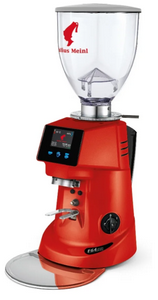
And yes, design matters. The F64 EVO comes factory-fitted in Glossy Red (RAL 3002). Paired with Julius Meinl (red accent, Viennese aesthetics, premium look), this helps create a visually cohesive unit.
Important information from the manual: the coffee grinder is designed for professional use by qualified personnel.
And the controls for everyday use are designed for the bar: the manual describes the single and double grind modes and continuous grinding.
How to adjust the Fiorenzato F64 grind for the perfect espresso
There’s no “universal number”—and that’s okay. Julius Meinl provides guidelines for water, dosage, and time, and then recommends adjusting the grind to stay within the specified range.
Next comes the “reliable setting” algorithm, which is based on measurements.
Preparation: Only what really matters
- Scales (preferably with an accuracy of 0.1 g).
- Timer.
- Fresh beans and a clean, dry portafilter.
- Basic water guidelines: Julius Meinl specifies a temperature of 89–93°C for espresso and water hardness parameters in °dH.
Choose a “basic” recipe and build on it.
Julius Meinl’s classic recommendations for a single espresso are 8-10 g freshly ground coffee, 20-30 seconds, and 25-35 ml of the drink (including the crema).
If you’re setting up a double shot, it’s convenient to use the output weight: the Julius Meinl website lists an example of 18 g input / 38 g output / 28-29 seconds (18 g basket).
For a double, controlling the output by weight is more practical: this reduces “cheating” due to the crema.
Fixing the bookmark speeds up setup.
Select the basket (usually “double”) and set the dose (for example, 18 g). It’s best to change only one parameter at a time —this approach is directly recommended in espresso training materials.
Adjusting the grind on the F64: where to turn and how to avoid jamming the burrs.
The mechanics are described in the manual: the adjustment dial is under the hopper with a locking mechanism. Coarser grinds require clockwise rotation (with the locking mechanism pressed down), finer grinds require counterclockwise rotation.
An important practical detail: adjustments must be made with the motor running—the manufacturer specifically states this.
Translated into plain English: when you go to a finer grind, the burrs move closer together, and if there are many beans between them, jamming can occur. Therefore, small steps and the motor running.
After each adjustment, perform a “grind.”
Some of the old grounds remain inside. Therefore, after making adjustments, grind 1–2 portions and do not add them to the drink—this prevents any residual grounds from affecting the next cup.
A quick diagnosis of Fiorenzato pour-over
formulates the basic rule very straightforwardly: if the espresso flows too quickly, the grind is coarse; if too slowly, the grind is fine.
From there, it’s simple:
- we want to slow down the flow → a little shallower;
- We want to speed it up → a little bigger.
A taste cheat sheet (when the numbers are “normal” but you don’t like the taste)
Julius Meinl, in his analysis of the bitterness problem, describes the logic as follows: bitterness is often associated with overextraction, and the basic control is to maintain the dose and adjust the grind to achieve 20-30 seconds per 25-35 ml.
If the taste is watery/sour and the pour is too fast, go back to the grind and make it finer.
Time-based dosing (in seconds): how to “link” the weight and avoid wasting coffee.
The F64 EVO allows you to adjust portions in seconds.
Here’s how: first, adjust the grind to get the desired brew time and flavor, then adjust the seconds on the scale to get a consistent dose.
Stability: Cleaning, Wear, Overheating, and Coffee Saving
A common cause of “yesterday’s coffee tasted better” is dirt and worn burrs. The manufacturer emphasizes that the grinder must be disconnected from the power supply before cleaning. Regularly checking the burrs’ condition is also important: good burrs ensure a high-quality grind, higher productivity, and less overheating.
Plus, the F64 EVO has an automatic cooling fan (it’s activated electronically).
The bottom line is simple: regular cleaning and timely burr replacement save coffee more often than they waste time.
Julius Meinl and the Red F64: Aesthetics, Marketing, and Guest Experience
In HoReCa, taste and visuals work hand in hand. Julius Meinl promotes Viennese coffee culture at the brand level, emphasizing that strong service includes equipment support and thoughtful branding.
In its marketing materials, Julius Meinl specifically emphasizes that Viennese coffee culture is recognized by UNESCO, and its branded materials help create a recognizable style.
And here the red F64 EVO (Glossy Red RAL 3002) becomes not just a piece of equipment, but a tool for the “display” image of the counter.
By the way, juliusmeinl.uz already offers Fiorenzato-branded models in the coffee grinder section (for example, the E64 EVO and F5), so the Julius Meinl × Fiorenzato combination is quite practical for HoReCa.
If you need coffee with an easy-to-adjust grind, choose a simple espresso blend. For example, the Julius Meinl Espresso Spezial is in the catalog.
And about profit and control. The description of the juliusmeinl.uz website update mentions a partner area with a personal account for orders, sales analytics, and exclusive promotions—this helps systematically manage a coffee shop and monitor its statistics.
Mini-FAQ Questions and Answers.
Which way do you turn the F64 grinder knob to make the grind finer?
Counterclockwise for finer grinds, clockwise for coarser grinds; keep the grinder locked.
The espresso is pouring too quickly—what should I change first?
Finen the grind: the manual describes this as a sign of too coarse a grind.
After changing the grind, do you need to regrind before the next cup?
Yes: 1–2 servings after adjusting the grind to ensure that no coffee from the previous grind is added to the drink.
What numbers should I use as a starting point?
Julius Meinl: 20–30 seconds for 25–35 ml; for a double, 18 g input / 38 g output / 28–29 seconds.
Can the grinder be adjusted when the grinder is turned off?
The manufacturer specifies that the grinder should be adjusted with the motor running.
Why do my settings drift from day to day?
Humidity, temperature, and bean condition fluctuate—even the F64 EVO display shows these parameters.